


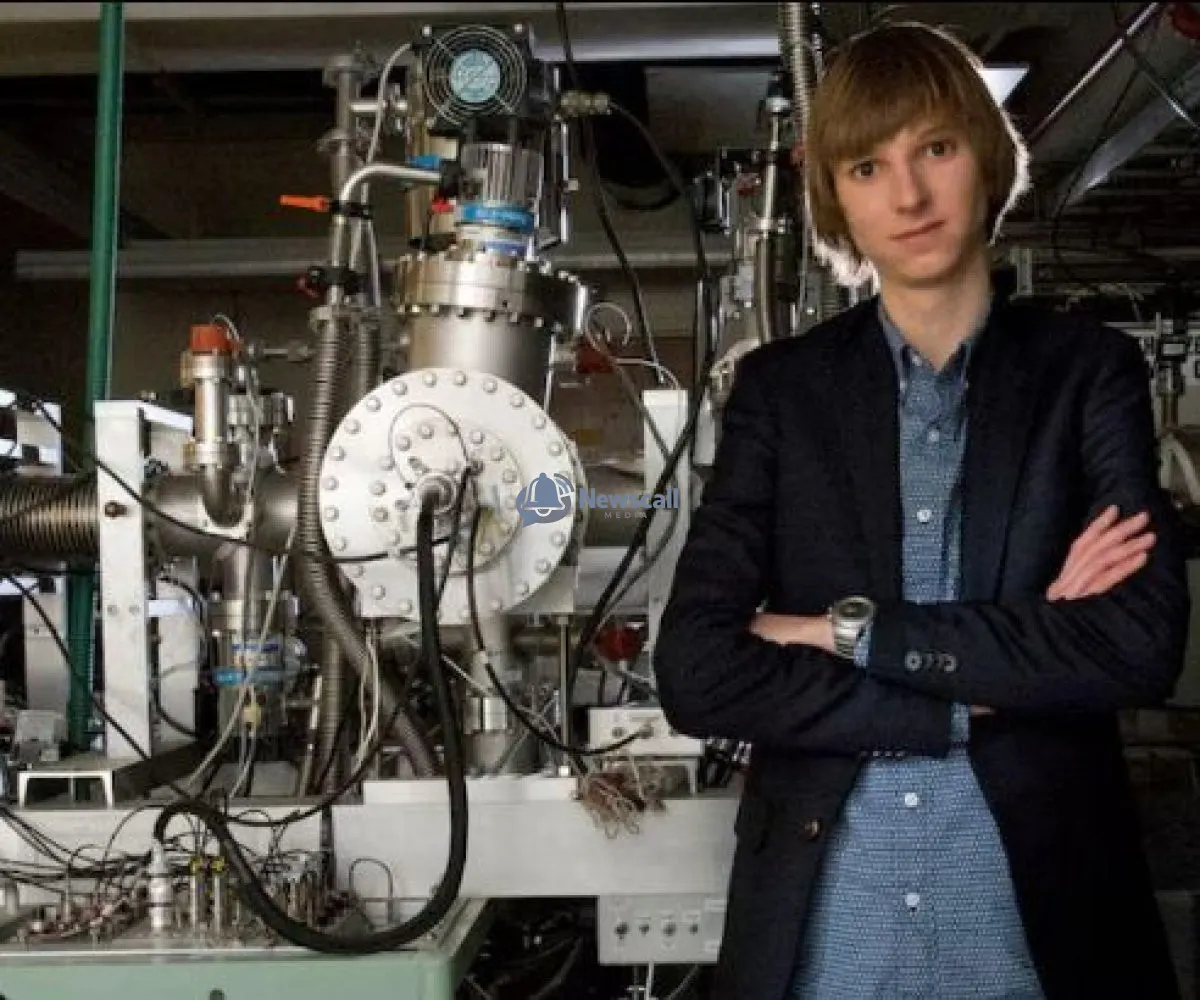
He Built a Nuclear Fusion Reactor as a Teenager. What Made Him Different?
Most teenagers who become interested in science start with relatively small experiments. They might build a simple circuit, take apart an old radio, or try to understand why a magnet attracts metal.
Taylor Wilson had a considerably more ambitious question: could he build a device that produces nuclear fusion?
By his early teens, the American science enthusiast was already experimenting with nuclear physics. At 14, he began pursuing the construction of a fusion device. By 14, he had achieved nuclear fusion in a homemade apparatus, making him one of the youngest people known to have accomplished the feat.
The achievement attracted international attention because nuclear fusion is not an ordinary science-fair experiment. It is the process that powers the Sun and other stars, releasing energy when light atomic nuclei combine under the right conditions.
Scientists have spent decades developing enormous facilities, sophisticated magnets and powerful lasers to study fusion. Wilson was working toward the same fundamental reaction in a much smaller setting.
His story raises a fascinating question: what does it take for a teenager to tackle a scientific challenge that has occupied professional researchers for generations?
The answer involves curiosity, persistence, a willingness to learn difficult material, and an important distinction between demonstrating a scientific reaction and turning it into a practical energy source.
Wilson grew up in Texarkana, Arkansas, and showed an early interest in science. His curiosity extended beyond reading about famous experiments. He wanted to understand how things worked by building and testing them himself.
Nuclear science eventually became a central focus. Instead of treating the subject as something reserved for university laboratories, Wilson approached it as a field he could explore through independent study and carefully designed experiments.
That ambition led him to an extraordinarily difficult problem.
Nuclear fusion happens when atomic nuclei combine to form a heavier nucleus. Under suitable conditions, the resulting products can release energy. The Sun accomplishes this through the extreme temperatures and pressures in its core, where gravity helps keep the fusion process going.
Reproducing fusion on Earth is much harder.
Atomic nuclei carry positive electrical charges, so they repel one another. To bring them close enough for fusion to occur, scientists must create conditions that allow them to overcome this repulsion. In experimental devices, that generally means heating fuel to extremely high temperatures and confining the resulting plasma long enough for some fusion reactions to take place.
The engineering challenge does not end when fusion occurs. A useful power plant must produce more usable energy than the entire system consumes, sustain the reaction under practical conditions, manage intense heat and radiation, and operate reliably and economically.
Wilson's achievement belonged to a different category: demonstrating that fusion reactions could occur in a compact, homemade experimental device.
The apparatus he built was a fusor, a type of inertial electrostatic confinement device. In simplified terms, a fusor uses an electric field to accelerate charged particles toward a central region, where some of them collide with enough energy to fuse.
It is an ingenious demonstration of nuclear physics. It is also a reminder that a device can produce a genuine scientific result without being a viable power source.
That distinction is essential to understanding the story.
Wilson did not build a machine capable of powering homes or competing with a commercial electricity plant. His fusor consumed energy, and the fusion reactions it produced did not generate net usable power. Commercial fusion remains a formidable scientific and engineering challenge even for well-funded research organizations.
But that limitation does not erase the significance of what he accomplished.
In science, a successful demonstration can establish that a process is possible under particular conditions. It can also develop the experimenter's understanding of physics, electronics, materials and measurement. Such a result is different from solving every problem required to turn a discovery into an industrial technology.
Wilson's work demonstrated an unusual level of initiative for someone so young. He had to engage with concepts that are difficult even for students pursuing advanced science and engineering. His experiment demanded more than enthusiasm: it required learning enough theory to build a functioning apparatus and understand what its results meant.
That is perhaps the most interesting part of his story for anyone fascinated by innovation.
People often imagine that inventors begin with a brilliant flash of inspiration. In reality, meaningful technical achievements usually require a long period of learning, experimentation and adjustment. Curiosity starts the process, but sustained work turns it into something tangible.
Wilson's story also shows why access to knowledge matters. Scientific ideas once confined largely to specialist institutions can now be explored through textbooks, digital resources, educational communities and increasingly accessible components. That does not make advanced experimentation easy or remove the need for expert guidance, but it can lower some barriers to learning.
There is a second lesson here: innovation is not always about inventing an entirely new physical principle. Sometimes it is about finding a way to explore an established principle with unusual determination, creativity or resourcefulness.
Fusion itself was not Wilson's discovery. Scientists had been studying nuclear fusion long before he was born. His achievement was constructing a device capable of demonstrating it at an exceptionally young age.
That distinction makes his story more impressive, not less. It places the accomplishment in its proper scientific context rather than turning it into a myth about a teenager solving the world's energy problems.
Fusion research remains important because its potential is enormous. Certain fusion reactions can release substantial energy from relatively small amounts of fuel, and some proposed fuel cycles could produce fewer long-lived radioactive wastes than conventional nuclear fission systems. Yet fusion also presents serious challenges involving materials, fuel supply, neutron damage, heat extraction, maintenance and cost. Its environmental and safety profile depends on the particular technology and fuel cycle.
Researchers around the world continue to investigate different approaches, from magnetic confinement machines such as tokamaks to laser-driven inertial confinement. No single demonstration has removed the practical obstacles to commercial fusion power.
Wilson's early experiment did not solve those problems. It showed that someone still in his teens could engage directly with one of physics' most demanding subjects and produce a real experimental result.
His later work continued to involve science, technology and entrepreneurship, including research and development related to nuclear detection and security. That broader trajectory matters because innovation often develops across several stages: learning a field, demonstrating a capability, discovering where it could be useful, and then working through the practical demands of deployment.
Not every person who builds something remarkable as a teenager will become a famous inventor. Nor should young people have to produce extraordinary achievements to justify their interest in science. But Wilson's story offers an encouraging reminder that age alone does not determine how deeply someone can engage with a difficult idea.
The more useful question is not whether every teenager should attempt something as ambitious as building a fusion device. It is whether we give curious young people enough room to ask difficult questions, develop serious skills and pursue projects that stretch their understanding.
Sometimes the first step toward a major technological breakthrough is not a billion-dollar laboratory. It is a person who refuses to leave a question unanswered.
Taylor Wilson did not solve nuclear fusion. He accomplished something narrower, concrete and remarkable: he demonstrated fusion in a homemade device while still a teenager.
And that is enough to make his story worth telling.

Victor Oluebubechukwu Akuma.
Creative writer


